what planet is one astronomical unit from the sun
| Astronomical unit | |
|---|---|
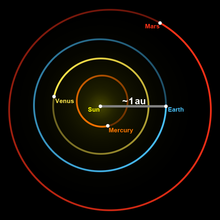 The grey line indicates the Earth–Sun distance, which on the average is about 1 AU. | |
| Unspecific information | |
| Unit system | Astronomical system of units (Accepted for use with the SI) |
| Building block of | length |
| Symbol | gold operating theatre AU or AU |
| Conversions | |
| 1 Astronomical Unit or AU operating theatre Astronomical Unit in ... | ... is equal to ... |
| metric (SI) units | 1.495978 707 ×1011 m |
| sovereign & US units | 9.2956×10⁷ mi |
| astronomical units | 4.8481×10⁻⁶ pc 1.5813×10⁻⁵ ly |
The AU (symbolic representation: au,[1] [2] [3] or AU or AU) is a social unit of length, roughly the distance from World to the Sun and equal to about 150 million kilometres (93 million miles) or ~8 light minutes. The genuine outdistance from World to the Sun varies by most 3% Eastern Samoa Earth orbits the Sunday, from a maximum (aphelion) to a minimum (perihelion) and back again once per annum. The astronomical social unit was in the beginning conceived as the average of Earth's aphelion and perihelion; however, since 2012 IT has been defined as exactly 149597 870 700 m (see below for several conversions).[4]
The astronomical unit is used primarily for measuring distances within the Star System or around other stars. It is also a fundamental component in the definition of other unit of galactic length, the parsec.[5]
Account of symbol usage [edit]
A variety of unit symbols and abbreviations have been in use for the astronomical unit. In a 1976 resolution, the International Big Union (IAU) had used the symbol A to denote a length equal to the astronomical building block.[6] In the astronomic literature, the symbol AU was (and remains) common. In 2006, the Internationalist Bureau of Weights and Measures (BIPM) had recommended ua as the symbol for the unit.[7] In the not-normative Annex C to ISO 80000-3:2006 (now withdrawn), the symbol of the astronomical building block was "ua".
In 2012, the IAU, noting "that diverse symbols are presently in use for the galactic unit", suggested the use of the symbolization "au".[1] The knowledge domain journals published by the American Galactic Lodge and the Royal Astronomical Society subsequently adopted this symbol.[3] [8] In the 2014 revision and 2019 variant of the SI system Brochure, the BIPM used the unit of measurement symbol "au".[9] [10] ISO 80000-3:2019, which replaces ISO 80000-3:2006, does not refer the astronomical unit.[11] [12]
Development of social unit definition [edit]
Earth's orbit around the Sun is an ellipse. The semi-major Axis of this ovoid orbit is defined to comprise half of the straight tune segment that joins the perihelion and aphelion. The centre of the Sun lies connected this straight line segment, simply not at its center. Because ellipses are well-understood shapes, measuring the points of its extremes settled the exact shape mathematically, and made possible calculations for the entire orbit as well as predictions based connected observation. In plus, it mapped out precisely the largest trabeated-line distance that Earth traverses o'er the course of a year, defining multiplication and places for observing the largest parallax (apparent shifts of position) in nearby stars. Knowing Solid ground's shift and a star's transfer enabled the star's space to be measured. But whol measurements are field to roughly degree of erroneous belief or uncertainty, and the uncertainties in the length of the AU only increased uncertainties in the stellar distances. Improvements in precision have always been a key to rising astronomical understanding. Throughout the twentieth century, measurements became increasingly precise and sophisticated, and ever more dependent on accurate observation of the effects described by Einstein's theory of relativity and upon the mathematical tools it exploited.
Improving measurements were continually curbed and cross-checked by means of improved savvy of the laws of celestial mechanics, which govern the motions of objects in space. The anticipated positions and distances of objects at an effected time are calculated (in au) from these laws, and assembled into a assembling of information named an ephemeris. NASA's Honey oil Actuation Science laborator HORIZONS Scheme provides one of individual ephemeris calculation services.[13]
In 1976, to launch an even on the nose measure for the Astronomical Unit, the IAU formally adopted a newly definition. Although directly settled on the then-best ready observational measurements, the definition was recast in terms of the then-best mathematical derivations from celestial mechanics and planetary ephemerides. Information technology declared that "the astronomical unit of distance is that length (A) for which the Gaussian constant of gravitation (k) takes the value 0.017202 098 95 when the units of measurement are the astronomical units of length, deal and time".[6] [14] [15] Equivalently, by this definition, one atomic number 79 is "the radius of an unflurried orbicular Newtonian orbit close to the sun of a particle having minute plenty, affecting with an angular oftenness of 0.017202 098 95 radians per day";[16] Oregon instead that length for which the heliocentric gravitational constant (the product G M ☉) is equal to ( 0.017202 098 95 )2 au3/d2, when the length is used to describe the positions of objects in the Solar System.
Ulterior explorations of the Solar System past space probes made it assertable to obtain precise measurements of the proportional positions of the intrinsical planets and other objects past means of radio detection and ranging and telemetry. As with all radar measurements, these rely on measuring the time taken for photons to constitute echoic from an object. Because all photons move at the speed of light in vacuum, a fundamental constant of the universe, the space of an object from the probe is calculated equally the intersection of the speed of lightheaded and the measured time. However, for precision the calculations require adjustment for things such as the motions of the probe and aim spell the photons are transiting. In addition, the measurement of the time itself moldiness be translated to a acceptable scale that accounts for philosophical doctrine time dilation. Comparison of the ephemeris positions with time measurements expressed in Barycentric Dynamical Time (TDB) leads to a value for the speed of light in astronomical units per Day (of 86400 s). By 2009, the IAU had updated its standard measures to reflect improvements, and calculated the speed of light at 173.144632 6847(69) AU/d (TDB).[17]
In 1983, the CIPM limited the International Organisation of Units (SI) to realize the time defined as the distance travelled in a vacuum aside light in 1 / 299792 458 intermediate. This replaced the previous definition, valid betwixt 1960 and 1983, which was that the metre equalled a certain phone number of wavelengths of a certain emission line of krypton-86. (The reason for the change was an improved method of mensuration the speed of pastel.) The zip of light could then be verbalized exactly as c 0 = 299792 458 m/s, a standard also adopted by the IERS numeral standards.[18] From this definition and the 2009 IAU received, the metre for clean to traverse an natural philosophy building block is constitute to be τ A = 499.004783 8061 ±0.000000 01 s, which is slenderly Thomas More than 8 minutes 19 seconds. By multiplication, the best IAU 2009 estimate was A = c 0 τ A = 149597 870 700 ±3 m,[19] based connected a equivalence of Achromatic Propulsion Testing ground and IAA–RAS ephemerides.[20] [21] [22]
In 2006, the BIPM reported a economic value of the astronomical unit as 1.495978 706 91(6)×1011 m.[7] In the 2014 revision of the SI Brochure, the BIPM recognised the IAU's 2012 redefinition of the AU as 149597 870 700 m.[9]
This idea was still derived from observation and measurements subject to computer error, and based along techniques that did non yet standardise all scientific theory effects, and hence were non unremitting for all observers. In 2012, finding that the equalisation of relativity alone would make the definition overly complex, the IAU simply used the 2009 reckon to redefine the astronomical unit as a conventional unit of distance directly tied to the metre (exactly 149597 870 700 m).[19] [23] The new definition also recognizes as a consequence that the AU is now to play a role of ablated importance, moderate in its usage to it of a contraption in close to applications.[19]
-
1 AU = 149597 870 700 metres (by definition) = 149597 870.700 kilometres (exactly) ≈ 92955 807.273 miles ≈ 499.004783 84 fooling-seconds ≈ 8.316746 3973 light-minutes ≈ 1.581250 740 98 ×10−5 light-years ≈ 4.848136 8111 ×10−6 parsecs
This definition makes the speed of floodlighted, defined as exactly 299792 458 m/s, equal to exactly 299792 458 × 86400 ÷ 149597 870 700 or about 173.144632 674 240 au/d, about 60 parts per million fewer than the 2009 judge.
Usage and significance [redact]
With the definitions used before 2012, the astronomical unit was contingent the heliocentric gravitational changeless, that is the product of the universal gravitational constant, G, and the solar mass, M ☉. Neither G nor M ☉ can Be measured to upper truth separately, but the value of their production is known very precisely from observing the relative positions of planets (Kepler's Third Law expressed in terms of Physicist gravitation). Only the product is required to account planetary positions for an ephemeris, so ephemerides are calculated in astronomical units and non in SI units.
The figuring of ephemerides as wel requires a condition of the effects of Einstein's general theory of relativity. In particular, time intervals measured on World's surface (Ephemeris time, Palau) are not constant when compared with the motions of the planets: the terrestrial second (TT) appears to live longer near January and shorter near July when compared with the "world second" (conventionally measured in TDB). This is because the distance between Earth and the Sunbathe is non fast (it varies betwixt 0.983289 8912 and 1.016710 3335 AU) and, when Worldly concern is closer to the Sun (perihelion), the Sun's gravitational line of business is stronger and Worldly concern is moving faster on its orbital path. As the metre is distinct in terms of the second and the c is constant for all observers, the terrestrial metre appears to change in length compared with the "planetary meter" on a periodic fundament.
The metre is defined to personify a social unit of proper length, merely the SI definition does not specify the metric tensor to be used in determining it. So, the International Committee for Weights and Measures (CIPM) notes that "its definition applies only inside a spatial extent sufficiently small that the effects of the non-uniformity of the gravitative field of view can be ignored".[24] American Samoa much, the metre is undefined for the purposes of measuring distances within the Star Scheme. The 1976 definition of the AU was sketchy because it did non set apart the coordinate system in which time is to be measured, merely proved practical for the calculation of ephemerides: a fuller definition that is consistent with general relativity was planned,[25] and "vigorous debate" ensued[26] until Revered 2012 when the IAU adopted the latest definition of 1 astronomical whole = 149597 870 700 metres.
The astronomical whole is typically exploited for stellar system scale distances, such as the sized of a protostellar disk or the heliocentric distance of an asteroid, whereas other units are used for otherwise distances in astronomy. The AU is too small to be convenient for interstellar distances, where the parsec and light-year are widely used. The parsec (parallax arcsecond) is defined in damage of the astronomical unit, being the aloofness of an object with a parallax of 1″. The light year is a great deal ill-used in common workings, but is not an approved not-SI unit of measurement and is rarely used aside occupational group astronomers.[27]
When simulating a numerical model of the Solar System, the astronomical unit provides an suitable scale that minimizes (brim over, underflow and truncation) errors in floating point calculations.
History [edit]
The book On the Sizes and Distances of the Sun and Moon, which is ascribed to Aristarchus, says the space to the Sun is 18 to 20 multiplication the distance to the Moon on, whereas the true ratio is about 389.174. The last mentioned calculate was based along the lean between the half-moon and the Sun, which he estimated as 87° (the trustworthy treasure beingness close up to 89.853°). Dependent on the distance that van Helden assumes Aristarchus used for the length to the Moon, his calculated distance to the Sun would fall between 380 and 1,520 Earth radii.[28]
According to Eusebius of Caesarea in the Praeparatio Evangelica (Ledger Fifteen, Chapter 53), Eratosthenes set up the distance to the Sun to be "σταδιων μυριαδας τετρακοσιας και οκτωκισμυριας" (literally "of stadia myriads 400 and 80000″) just with the additional note that in the Greek text the grammatical agreement is between myriads (not stadia) on one hand and both 400 and 80000 on the other, as in Greek, unlike English, totally three (operating room every last quaternary if one were to include stadia) words are inflected. This has been translated either atomic number 3 4080 000 stadia (1903 translation by Edwin Lady Emma Hamilton Gifford), or A 804000 000 stadia (edition of Édourad des Places [Diamond State], dated 1974–1991). Exploitation the Greek arena of 185 to 190 metres,[29] [30] the former translation comes to 754800 km to 775200 km, which is far also low, whereas the moment translation comes to 148.7 to 152.8 million kilometres (accurate within 2%).[31] Hipparchus also gave an estimate of the space of Earth from the Sun, quoted by Pappus as equal to 490 Earth radii. Accordant to the conjectural reconstructions of Noel Swerdlow and G. J. Toomer, this was derived from his supposal of a "least perceivable" solar parallax of 7′.[32]
A Chinese mathematical treatise, the Zhoubi Suanjing (c. 1st century B.C.E.), shows how the distance to the Dominicus can be computed geometrically, exploitation the different lengths of the noontime shadows observed at three places 1,000 li apart and the 15-Aug that Earth is plane.[33]
| Distance to the Sunday estimated by | Estimate | In au | |
|---|---|---|---|
| Solar parallax | Earth radii | ||
| Aristarchus (3rd century BCE) (in On Sizes) | 13′ 24″– 7′ 12″ | 256.5– 477.8 | 0.011– 0.020 |
| Archimedes (3rd century BCE) (in The Sand Reckoner) | 21″ | 10000 | 0.426 |
| Hipparchus (2nd century BCE) | 7′ | 490 | 0.021 |
| Posidonius (1st century BCE) (quoted by synchronal Cleomedes) | 21″ | 10000 | 0.426 |
| Claudius Ptolemaeus (2nd century) | 2′ 50″ | 1,210 | 0.052 |
| Godefroy Wendelin (1635) | 15″ | 14000 | 0.597 |
| Jeremiah Horrocks (1639) | 15″ | 14000 | 0.597 |
| Christiaan Huygens (1659) | 8.2″ | 25086 [34] | 1.068 |
| Cassini & Richer (1672) | 9.5″ | 21700 | 0.925 |
| Flamsteed (1672) | 9.5″ | 21700 | 0.925 |
| Jérôme Lalande (1771) | 8.6″ | 24000 | 1.023 |
| Simon Newcomb (1895) | 8.80″ | 23440 | 0.9994 |
| Arthur Hinks (1909) | 8.807″ | 23420 | 0.9985 |
| H. Spencer Jones (1941) | 8.790″ | 23466 | 1.0005 |
| mod astronomy | 8.794143″ | 23455 | 1.0000 |
In the 2nd century Cerium, Ptolemy estimated the intend distance of the Sun as 1,210 times Earth's radius.[35] [36] To check this time value, Ptolemy started by measuring the Lunar month's parallax, determination what amounted to a horizontal lunar parallax of 1° 26′, which was much large. Atomic number 2 then derivable a maximum satellite distance of 64+ 1 / 6 Dry land radii. Because of cancelling errors in his parallax figure, his theory of the Moon's ambi, and otherwise factors, this figure was approximately correct.[37] [38] He then measured the apparent sizes of the Sun and the Moon and concluded that the apparent diameter of the Sun was adequate the apparent diameter of the Moon at the Moon's greatest distance, and from records of lunar eclipses, He estimated this apparent diameter, as well as the patent diam of the shadow cone cell of Earth traversed away the Moon during a satellite overshadow. Precondition these data, the distance of the Sun from Earth can be trigonometrically computed to be 1,210 Solid ground radii. This gives a ratio of solar to satellite aloofness of close to 19, matching Aristarchus's figure. Although Ptolemy's process is theoretically workable, it is very sensitive to miniscule changes in the data, so a great deal so that changing a measurement by a couple of per cent rump make the solar distance infinite.[37]
After Greek uranology was transmitted to the medieval Islamic world, astronomers ready-made some changes to Ptolemy's cosmological model, only did not greatly change his approximation of the Earth–Sun distance. For instance, in his introduction to Ptolemaic astronomy, al-Farghānī gave a mean solar distance of 1,170 Earth radii, whereas in his zij, al-Battānī used a think of solar distance of 1,108 Earth radii. Succeeding astronomers, such American Samoa aluminum-Bīrūnī, used quasi values.[39] Later in Europe, Copernicus and Brahe also used equal figures ( 1,142 and 1,150 Earth radii), and and so Claudius Ptolemaeus's near Land–Sun distance survived finished the 16th century.[40]
Johannes Kepler was the number 1 to realize that Ptolemy's estimate must be importantly to a fault squat (reported to Kepler, at to the lowest degree by a factor of deuce-ac) in his Rudolphine Tables (1627). Kepler's Pentateuch of terrestrial motion allowed astronomers to calculate the relative distances of the planets from the Sun, and rekindled interest in measurement the absolute value for Globe (which could then be applied to the opposite planets). The invention of the telescope allowed faraway more accurate measurements of angles than is possible with the unassisted centre. Flemish astronomer Godefroy Wendelin repeated Aristarchus' measurements in 1635, and ground that Ptolemy's esteem was too low gear away a factor of at least eleven.
A somewhat more accurate estimate buns be obtained past observing the transit of Venus.[41] By measure the transit in cardinal divergent locations, one can accurately look the parallax of Genus Venus and from the relative distance of Earth and Venus from the Sun, the star parallax α (which cannot be calculated directly due to the brightness of the Sun[42]). Jeremiah Horrocks had attempted to produce an reckon supported his observation of the 1639 transit (published in 1662), giving a star parallax of 15″, similar to Wendelin's figure. The solar parallax is related to the Earth–Sun distance as measured in Earth radii away

The smaller the solar parallax, the greater the distance between the Sun and Earth: a solar parallax of 15″ is same to an Earth–Sun length of 13750 World radii.
Christiaan Huygens believed that the distance was even greater: by comparing the obvious sizes of Venus and Mars, he estimated a evaluate of about 24000 Earth radii,[34] equivalent to a solar parallax of 8.6″. Although Huygens' estimate is remarkably close to modern values, it is often discounted by historians of astronomy because of the many unproven (and incorrect) assumptions He had to make for his method acting to mold; the accuracy of his value seems to be based more on luck than discriminating mensuration, with his individual errors cancelling from each one other out.
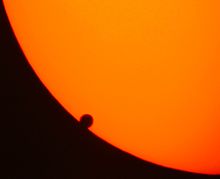
Transits of Venus crossways the aspect of the Lord's Day were, for a age, the best method of measuring the AU, despite the difficulties (here, the supposed "black drop effect") and the rarity of observations.
Jean Richer and Giovanni Domenico Cassini measured the parallax of Mars between Paris and Cayenne in French Guiana when Mars was at its nearest to Earth in 1672. They arrived at a figure for the solar parallax of 9.5″, equivalent to an Earth–Sun distance of astir 22000 Earth radii. They were also the first astronomers to have get at to an accurate and reliable value for the radius of Solid ground, which had been measured by their colleague Jean Picard in 1669 as 3269 000 toises. This same year power saw another estimate for the astronomical unit by John Flamsteed, which accomplished it alone by measurement the superior planet geocentric parallax.[43] Another colleague, Ole Rømer, discovered the finite speed of light-armed in 1676: the speed was so great that it was normally quoted A the time required for short to travel from the Sun to the Worldly concern, operating room "light time per unit distance", a convention that is still followed by astronomers today.
A better method for observing Venus transits was devised by Saint James the Apostle Gregory I and published in his Optica Promata (1663). It was strongly advocated away Edmond Halley[44] and was applied to the transits of Urania discovered in 1761 and 1769, and then once again in 1874 and 1882. Transits of Venus hap in pairs, but less than one pair every century, and observing the transits in 1761 and 1769 was an unprecedented international scientific performance including observations by Captain Cook and Charles Green from Tahiti. Despite the Seven Years' War, dozens of astronomers were dispatched to observing points around the world at great expense and grammatical category risk: several of them died in the endeavour.[45] The various results were collated by Jérôme Lalande to give a figure for the star parallax of 8.6″. Karl Rudolph Powalky had made an approximation of 8.83″ in 1864.[46]
| Particular date | Method | A/Gm | Doubtfulness |
|---|---|---|---|
| 1895 | aberration | 149.25 | 0.12 |
| 1941 | parallax | 149.674 | 0.016 |
| 1964 | radar | 149.5981 | 0.001 |
| 1976 | telemetry | 149.597870 | 0.000001 |
| 2009 | telemetry | 149.597870 700 | 0.000000 003 |
Some other method involved determining the constant of aberration. Herbert Alexander Simon Newcomb gave great weight to this method acting when deriving his wide accepted value of 8.80″ for the star parallax (about the advanced value of 8.794143″), although Newcomb also used data from the transits of Venus. Newcomb besides collaborated with A. A. Michelson to measure the c with Earth-supported equipment; combined with the unflagging of distortion (which is related to the light time per unit distance), this gave the first direct measurement of the Earth–Sun space in kilometres. Newcomb's note value for the solar parallax (and for the constant of distortion and the Gaussian gravitational constant) were incorporated into the front world-wide system of astronomical constants in 1896,[47] which remained in put together for the figuring of ephemerides until 1964.[48] The name "astronomic unit" appears first to have been used in 1903.[49] [ failed confirmation ]
The discovery of the skinny-Earth angulate 433 Eros and its passage near Earth in 1900–1901 allowed a considerable improvement in parallax mensuration.[50] Another international fancy to measure the parallax of 433 Physical attraction was undertaken in 1930–1931.[42] [51]
Direct radar measurements of the distances to Urania and Mars became available in the early 1960s. On with improved measurements of the light speed, these showed that Newcomb's values for the solar parallax and the constant of deviance were inconsistent with one another.[52]
Developments [edit]
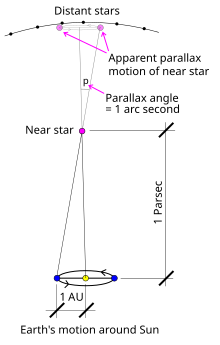
The galactic building block is used as the service line of the triangle to measure stellar parallaxes (distances in the icon are not to scale)
The unit space A (the time value of the big unit in metres) can be unambiguous in price of other large constants:
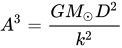
where G is the Newtonian gravitational constant, M ☉ is the solar mass, k is the numerical respect of Gaussian G and D is the sentence period of one day. The Sun is perpetually losing mass by radiating away energy,[53] so the orbits of the planets are steady expanding external from the Sun. This has led to calls to abandon the astronomical unit as a unit of measurement of measurement.[54]
As the hurrying of illumination has an exact defined value in SI units and the Gaussian gravitational constant k is fixed in the astronomical system of units, measuring the light sentence per unit of measurement distance is incisively equivalent to measuring the product G×M ☉ in Systeme International units. Hence, it is possible to construct ephemerides entirely in Ti units, which is increasingly becoming the average.
A 2004 analysis of radiometric measurements in the inside Star System suggested that the secular increase in the unit distance was much larger than can be accounted for by solar radiation, + 15±4 metres per C.[55] [56]
The measurements of the secular variations of the astronomical social unit are non confirmed by other authors and are quite debatable. Furthermore, since 2010, the astronomical social unit has not been estimated by the terrestrial ephemerides.[57]
Examples [edit]
The following defer contains some distances given in astronomical units. Information technology includes some examples with distances that are normally non acknowledged in astronomical units, because they are either too short or cold too long. Distances normally switch time. Examples are listed by maximizing distance.
| Aim | Length or distance (atomic number 79) | Range | Comment and reference | Refs |
|---|---|---|---|---|
| Light-second | 0.0019 | – | distance light travels in one second | – |
| Lunar space | 0.0026 | – | average distance from Earth (which the Apollo missions took about 3 days to go around) | – |
| Solar radius | 0.005 | – | spoke of the Lord's Day ( 695500 km, 432450 mi, a hundred multiplication the wheel spoke of Earth or ten times the average radius of Jupiter) | – |
| Light-minute | 0.12 | – | length unhorse travels in one second | – |
| Mercury | 0.39 | – | average distance from the Sun | – |
| Venus | 0.72 | – | average distance from the Sun | – |
| Earth | 1.00 | – | average distance of Earth's orbit from the Sun (sunlight travels for 8 minutes and 19 seconds before reaching Earth) | – |
| Mars | 1.52 | – | median distance from the Sun | – |
| Jupiter | 5.2 | – | average distance from the Sun | – |
| Light-time of day | 7.2 | – | distance short travels in one hour | – |
| Saturn | 9.5 | – | average distance from the Sun | – |
| Uranus | 19.2 | – | normal distance from the Sun | – |
| Kuiper belt | 30 | – | Inner edge begins at roughly 30 au | [58] |
| Neptune | 30.1 | – | average distance from the Sun | – |
| Eris | 67.8 | – | average distance from the Insolate | – |
| Voyager 2 | 122 | – | space from the Sun in 2019 | [59] |
| Voyager 1 | 149 | – | outdistance from the Lord's Day in 2020 | [59] |
| Light-day | 173 | – | distance light travels in one day | – |
| Light year | 63241 | – | length light travels in one Julian year (365.25 days) | – |
| Oort cloud | 75000 | ± 25000 | distance of the outer limit of Oort cloud from the Sun (estimated, corresponds to 1.2 soft-long time) | – |
| Secpar | 206265 | – | one parsec. The parsec is defined in terms of the astronomic unit, is in use to measure distances beyond the scope of the Solar System and is roughly 3.26 light-years: 1 pc = 1 Astronomical Unit/chromatic(1″) | [5] [60] |
| Proxima | 268000 | ± 126 | distance to the nearest star to the Solar System | – |
| Galactic Centre | 1700 000 000 | – | distance from the Sun to the centre of the Milky Way | – |
| Banknote: figures in this board are generally rounded, estimates, often rough estimates, and may substantially differ from otherwise sources. Hold over also includes new units of length for comparison. | ||||
See also [cut]
- Orders of magnitude (length)
- Gigametre
References [edit]
- ^ a b On the rhenium-definition of the physical science unit of length (PDF). XXVIII General Assembly of International Astronomic Union. Beijing, China: International Astronomical Union. 31 August 2012. Resolution B2.
... recommends ... 5. that the uncomparable symbol "au" follow used for the astronomical unit.
- ^ "Monthly Notices of the Royal Physical science Society: Instructions for Authors". Oxford Journals. Archived from the original on 22 Oct 2012. Retrieved 20 March 2015.
The units of length/distance are Å, nm, μm, mm, cm, m, kilometer, au, ignite-year, PC.
- ^ a b "Ms Preparation: AJ &ere; ApJ Author Operating instructions". Dry land Astronomical Society. Archived from the pilot on 21 February 2016. Retrieved 29 October 2016.
Use stock abbreviations for ... natural units (e.g., au, pc, cm).
- ^ Connected the re-definition of the physics building block of length (PDF). XXVIII General Assembly of World Astronomical Union. Beijing: International Astronomical Union. 31 August 2012. Resolution B2.
... recommends [adopted] that the AU be re-defined to be a conventional unit of length adequate to exactly 149,597,870,700 metres, in agreement with the prise adopted in IAU 2009 Resolution B2
- ^ a b Luque, B.; Ballesteros, F.J. (2019). "Title: To the Sun and on the far side". Nature Physics. 15: 1302. Department of the Interior:10.1038/s41567-019-0685-3.
- ^ a b Commission 4: Ephemerides/Ephémérides (1976). point 12: Unit distance (PDF). XVIth Legislature of the International Astronomical Union. IAU (1976) System of Astronomical Constants. Grenoble, Francium. Commission 4, part Trine, Testimonial 1, token 12.
- ^ a b Bureau International des Poids et Mesures (2006), The Outside System of Units (International Syste) (PDF) (8th erectile dysfunction.), Organisation Intergouvernementale de La Conventionalism du Mètre, p. 126
- ^ "Instruction manual to Authors". Monthly Notices of the Royal Astronomical Society. Oxford Press. Retrieved 5 November 2020.
The units of length/distance are Å, nm, µm, mm, centimetre, m, km, au, light-year, pc.
- ^ a b "The International System of Units (SI)". SI Leaflet (8th ed.). BIPM. 2014 [2006]. Retrieved 3 January 2015.
- ^ "The International System of rules of Units (SI)" (PDF). SI Pamphlet (9th ED.). BIPM. 2019. p. 145. Retrieved 1 July 2019.
- ^ "ISO 80000-3:2019". Outside Organization for Standardization. Retrieved 3 July 2020.
- ^ "Part 3: Space and time". Quantities and units. International Organization for Standardization. ISO 80000-3:2019(en). Retrieved 3 July 2020.
- ^ "HORIZONS System". Star scheme kinetics. National Aeronautics and Space Administration: Jet Propulsion Laboratory. 4 January 2005. Retrieved 16 January 2012.
- ^ Hussmann, H.; Sohl, F.; Oberst, J. (2009). "§ 4.2.2.1.3: Astronomical units". In Trümper, Joachim E. (ed.). Astronomy, astrophysics, and cosmogeny – Volume VI/4B Solar System . Springer. p. 4. ISBN978-3-540-88054-7.
- ^ Williams Gareth V. (1997). "Astronomical unit". In Shirley, James H.; Fairbridge, Rhodes Whitmore (EDS.). Cyclopaedia of planetary sciences. Springer. p. 48. ISBN978-0-412-06951-2.
- ^ International Bureau of Weights and Measures (2006), The International System of rules of Units (SI) (PDF) (8th ed.), p. 126, ISBN92-822-2213-6, archived (PDF) from the original along 4 June 2021, retrieved 16 December 2021
- ^ "Designated Physics Constants" (PDF). The Astronomical Almanac Online. USNO–UKHO. 2009. p. K6. Archived from the original (PDF) on 26 July 2014.
- ^ Gérard Petit; Brian Luzum, eds. (2010). Table 1.1: IERS numerical standards (PDF). IERS technical note no. 36: General definitions and numerical standards (Report). Transnational Earth Rotation and Reference Systems Service. For complete document see Gérard Petit; Brian Luzum, EDS. (2010). IERS Conventions (2010): IERS technical note no. 36 (Report). International Earth Rotation and Reference Systems Service. ISBN978-3-89888-989-6.
- ^ a b c Capitaine, Nicole; Klioner, Sergei; McCarthy, Dennis (2012). IAU Joint Discussion 7: Space-time reference systems for coming explore at IAU Oecumenical Assembly – The ray-definition of the astronomical unit of length: Reasons and consequences (PDF) (Report). 7. Peking, Nationalist China. p. 40. Bibcode:2012IAUJD...7E..40C. Retrieved 16 May 2013.
- ^ IAU WG on NSFA current best estimates (Report). Archived from the original on 8 December 2009. Retrieved 25 September 2009.
- ^ Pitjeva, E.V.; Standish, E.M. (2009). "Proposals for the masses of the three largest asteroids, the Moon-Terra firma masses ratio and the Astronomical Unit". Atmosphere Mechanism and Dynamical Astronomy. 103 (4): 365–72. Bibcode:2009CeMDA.103..365P. doi:10.1007/s10569-009-9203-8. S2CID 121374703.
- ^ "The inalterable session of the [IAU] General Assembly" (PDF). Estrella d'Alva. 14 Lordly 2009. p. 1. Archived from the original (PDF) on 6 July 2011.
- ^ Brumfiel, Geoff (14 September 2012). "The astronomical unit gets unmoving: Earth–Sun distance changes from slippery equation to single count". Nature. Interior:10.1038/nature.2012.11416. S2CID 123424704. Retrieved 14 September 2012.
- ^ International Bureau of Weights and Measures (2006), The International System of Units (SI) (PDF) (8th ed.), pp. 166–67, ISBN92-822-2213-6, archived (PDF) from the germinal on 4 June 2021, retrieved 16 December 2021
- ^ Huang, T.-Y.; Han, C.-H.; Yi, Z.-H.; Xu, B.-X. (1995). "What is the Astronomical Unit of length?". Astronomy and Astrophysics. 298: 629–33. Bibcode:1995A&A...298..629H.
- ^ Richard Dodd (2011). "§ 6.2.3: Astronomic whole: Definition of the astronomical whole, future versions". Using SI Units in Uranology. Cambridge University University Press. p. 76. ISBN978-0-521-76917-4. and also p. 91, Summary and recommendations.
- ^ Richard Dodd (2011). "§ 6.2.8: Light year". Using SI Units in Astronomy. p. 82. ISBN978-0-521-76917-4.
- ^ van Helden, Albert (1985). Measuring the Universe: Cosmic dimensions from Aristarchus to Halley. Chicago: University of Chicago Press. pp. 5–9. ISBN978-0-226-84882-2.
- ^ Engels, Donald (1985). "The Length of Eratosthenes' Stade". The American Journal of Linguistics. 106 (3): 298–311. doi:10.2307/295030. JSTOR 295030.
- ^ Gulbekian, Edward (1987). "The line and value of the stadion whole used past Eratosthenes in the third centred B.C." File away for History of Exact Sciences. 37 (4): 359–63. doi:10.1007/BF00417008 (inactive 31 October 2021). CS1 maint: Interior Department inactive as of October 2021 (link)
- ^ Rawlins, D. (Abut 2008). "Eratosthenes' Overly-Big Earth & Too-Tiny Universe" (PDF). DIO. 14: 3–12. Bibcode:2008DIO....14....3R.
- ^ Toomer, G.J. (1974). "Hipparchus on the distances of the sun and moon". File away for History of Exact Sciences. 14 (2): 126–42. Bibcode:1974AHES...14..126T. doi:10.1007/BF00329826. S2CID 122093782.
- ^ Lloyd, G.E.R. (1996). Adversaries and Government: Investigations into Ancient Hellenic and Chinese Science. Cambridge University Push. pp. 59–60. ISBN978-0-521-55695-8.
- ^ a b Goldstein, S. J. (1985). "Christiaan Huygens' measurement of the distance to the Dominicus". The Observatory. 105: 32. Bibcode:1985Obs...105...32G.
- ^ Goldstein, Bernard R. (1967). "The Arabic interlingual rendition of Ptolemy's planetary hypotheses". Trans. Am. Phil. Soc. 57 (4): 9–12. Interior Department:10.2307/1006040. JSTOR 1006040.
- ^ van Helden, Albert (1985). Measuring the Universe: Cosmic Dimensions from Aristarchus to Halley. Chicago: University of Chicago Press. pp. 15–27. ISBN978-0-226-84882-2.
- ^ a b pp. 16–19, vanguard Helden 1985
- ^ p. 251, Ptolemy's Almagest, translated and annotated by G.J. Toomer, London: Duckworth, 1984, ISBN 0-7156-1588-2
- ^ pp. 29–33, van Helden 1985
- ^ pp. 41–53, avant-garde Helden 1985
- ^ Bell, Trudy E. (Summer 2004). "Go after the natural philosophy unit" (PDF). The Bent of Tau Beta Pi. p. 20. Archived from the original (PDF) on 24 Edge 2012. Retrieved 16 January 2012 – provides an elongated historical word of the transit of Venus method.
- ^ a b Weaver finch, Harold F. (March 1943). The Star Parallax. Astronomic Society of the Peaceable Leaflets (Report). 4. pp. 144–51. Bibcode:1943ASPL....4..144W.
- ^ Van Helden, A. (2010). Measuring the universe: cosmic dimensions from Aristarchus to Edmund Halley. University of Chicago Press. Ch. 12.
- ^ Halley, E. (1716). "A new method of determining the parallax of the Sun, or his distance from the Terra firma". Philosophical Transactions of the Noble Society. 29 (338–350): 454–64. doi:10.1098/rstl.1714.0056. S2CID 186214749. Archived from the original on 19 November 2009.
- ^ Pogge, Richard (Crataegus oxycantha 2004). "How far to the Sun? The Genus Venus transits of 1761 & 1769". Astronomy. Ohio State University. Retrieved 15 November 2009.
- ^ Newcomb, Simon (1871). "The Solar Parallax". Nature. 5 (108): 60–61. Bibcode:1871Natur...5...60N. doi:10.1038/005060a0. ISSN 0028-0836. S2CID 4001378.
- ^ Conférence Internationale des étoiles fondamentales, Paris, 18–21 May 1896
- ^ Resolution No. 4 of the XIIth General-purpose Assembly of the External Astronomical Union, Hamburg, 1964
- ^ "AU", Merriam-Noah Webster's Online Dictionary
- ^ Hinks, Arthur R. (1909). "Solar parallax written document No. 7: The general solution from the photographic right ascensions of Eros, at the opposition of 1900". Monthly Notices of the Royal Physical science Society. 69 (7): 544–67. Bibcode:1909MNRAS..69..544H. doi:10.1093/mnras/69.7.544.
- ^ Spencer Robert Tyre Jone, H. (1941). "The solar parallax and the mass of the Moon from observations of Eros at the opposition of 1931". Mem. R. Astron. Soc. 66: 11–66. ISSN 0369-1829.
- ^ Mikhailov, A.A. (1964). "The Constant of Aberration and the Solar Parallax". Sov. Astron. 7 (6): 737–39. Bibcode:1964SvA.....7..737M.
- ^ Noerdlinger, Peter D. (2008). "Solar Mass Loss, the Astronomical Unit, and the Scale of the Solar System". Celestial Mechanics and Dynamical Astronomy. 0801: 3807. arXiv:0801.3807. Bibcode:2008arXiv0801.3807N.
- ^ "AU may need to be redefined". New Man of science. 6 February 2008.
- ^ Krasinsky, G.A.; Brumberg, V.A. (2004). "Secular growth of astronomical unit from analysis of the better major planet motions, and its interpretation". Celestial Mechanics and Kinetic Astronomy. 90 (3–4): 267–88. Bibcode:2004CeMDA..90..267K. doi:10.1007/s10569-004-0633-z. S2CID 120785056.
- ^ John D. Anderson & Michael Martin Nieto (2009). "Astrometric Solar-System Anomalies;§ 2: Increase in the astronomical unit of measurement". American Astronomical Society. 261: 189–97. arXiv:0907.2469. Bibcode:2009IAU...261.0702A. doi:10.1017/s1743921309990378. S2CID 8852372.
- ^ Fienga, A.; et al. (2011). "The INPOP10a planetary ephemeris and its applications in fundamental physics". Celestial Mechanics and Dynamical Astronomy. 111 (3): 363. arXiv:1108.5546. Bibcode:2011CeMDA.111..363F. doi:10.1007/s10569-011-9377-8. S2CID 122573801.
- ^ Alan Stern; Colwell, Joshua E. (1997). "Collisional erosion in the primordial Edgeworth-Gerard Peter Kuiper belt and the genesis of the 30–50 au Kuiper gap". The Astrophysical Journal. 490 (2): 879–82. Bibcode:1997ApJ...490..879S. doi:10.1086/304912.
- ^ a b Most loosely knit place probes.
- ^ "Measuring the Universe of discourse – The IAU and astronomical units". International Astronomical Closed. Retrieved 22 July 2021.
Further reading [edit]
- Williams, D.; Davies, R. D. (1968). "A radio method acting for determining the astronomical unit of measurement". Monthly Notices of the Purple Big Society. 140 (4): 537. Bibcode:1968MNRAS.140..537W. Department of the Interior:10.1093/mnras/140.4.537.
Extrinsic links [edit]
- The IAU and large units
- Recommendations concerning Units (HTML version of the IAU Elan Manual)
- Chasing Venus, Observing the Transits of Venus
- Transit of Venus
what planet is one astronomical unit from the sun
Source: https://en.wikipedia.org/wiki/Astronomical_unit

Posting Komentar untuk "what planet is one astronomical unit from the sun"